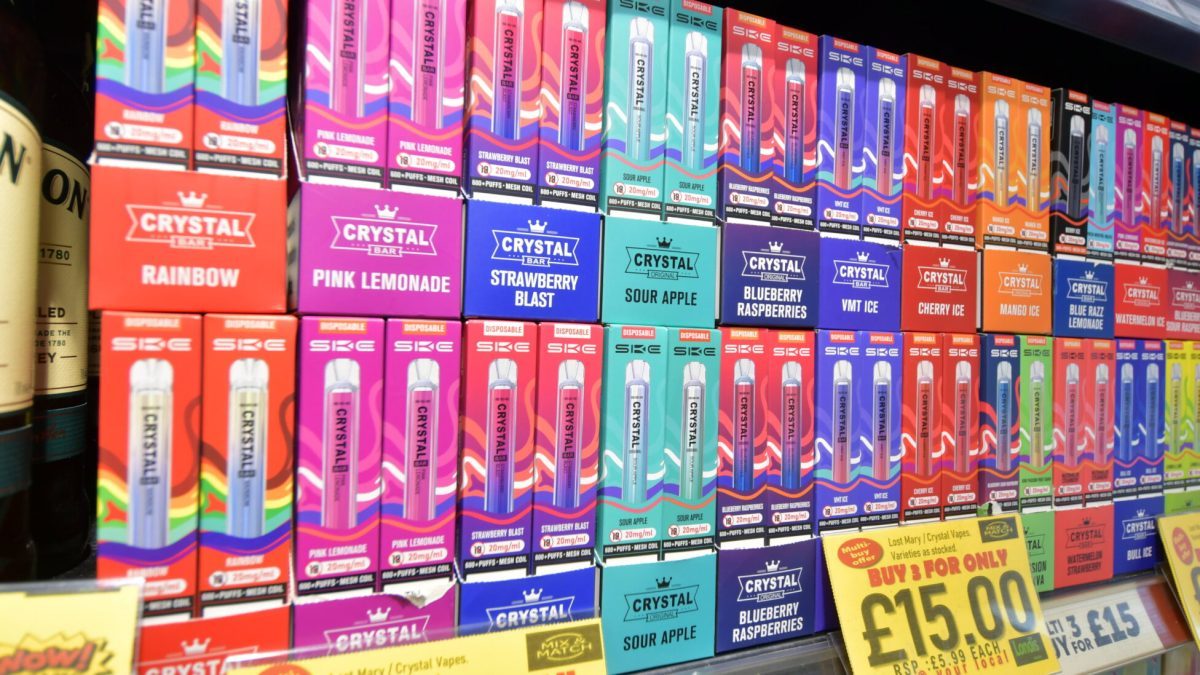
According to a report by Better Retailing on August 8th, concerns among UK retailers about the upcoming disposable e-cigarette ban are diminishing as more customers are turning to reusable alternatives.
A new study by Action on Smoking and Health (ASH) has found that disposable e-cigarettes are still a common choice among young users, but usage has decreased from 69% in the same period last year to 54%.
Five retailers interviewed last week stated that this trend is also reflected in other customers.
Coventry City Ahmed News, Arif Ahmed mentioned that
Currently, about 50% of our sales are disposable e-cigarettes, as they are much cheaper than refillable ones.
In e-cigarette shops, this ratio is even lower. Online e-cigarette shop Evapo reports that only 15% of customers currently use disposable e-cigarettes.
The UK's ban on disposable e-cigarettes will take effect on April 1, 2025. Currently, the country is regulating the flavors, packaging, advertising, and display of all remaining e-cigarette products.
Since the announcement of the ban on disposable e-cigarettes, many well-known disposable e-cigarette manufacturers or brand owners have introduced reusable, refillable, and rechargeable e-cigarettes. These include ELF BAR, who launched the refillable pod-style product ELFX in April, and LOST MARY, who introduced the LOST MARY BM6000 in May. It is understood that the LOST MARY BM6000 kit comes with a pre-filled 2ml pod (20mg nicotine) and a 10ml e-liquid refill container.
Earlier this year, an industry insider told Better Retailing that many major disposable e-cigarette brands will be launching high-capacity disposable devices to comply with regulations.
For stores, it will be easier as customers can still find products with the same appearance, texture, brand, and price even after the ban.
We welcome news tips, article submissions, interview requests, or comments on this piece.
Please contact us at info@2firsts.com, or reach out to Alan Zhao, CEO of 2Firsts, on LinkedIn
Notice
1. This article is intended solely for professional research purposes related to industry, technology, and policy. Any references to brands or products are made purely for objective description and do not constitute any form of endorsement, recommendation, or promotion by 2Firsts.
2. The use of nicotine-containing products — including, but not limited to, cigarettes, e-cigarettes, nicotine pouchand heated tobacco products — carries significant health risks. Users are responsible for complying with all applicable laws and regulations in their respective jurisdictions.
3. This article is not intended to serve as the basis for any investment decisions or financial advice. 2Firsts assumes no direct or indirect liability for any inaccuracies or errors in the content.
4. Access to this article is strictly prohibited for individuals below the legal age in their jurisdiction.
Copyright
This article is either an original work created by 2Firsts or a reproduction from third-party sources with proper attribution. All copyrights and usage rights belong to 2Firsts or the original content provider. Unauthorized reproduction, distribution, or any other form of unauthorized use by any individual or organization is strictly prohibited. Violators will be held legally accountable.
For copyright-related inquiries, please contact: info@2firsts.com
AI Assistance Disclaimer
This article may have been enhanced using AI tools to improve translation and editorial efficiency. However, due to technical limitations, inaccuracies may occur. Readers are encouraged to refer to the cited sources for the most accurate information.
We welcome any corrections or feedback. Please contact us at: info@2firsts.com