Keith Ellison Urges Retailers to Stop Selling Unauthorized E-Cigarette Products

Regulations by 2FIRSTS.ai
Sep.12.2024
Keith Ellison Urges Retailers to Stop Selling Unauthorized E-Cigarette Products
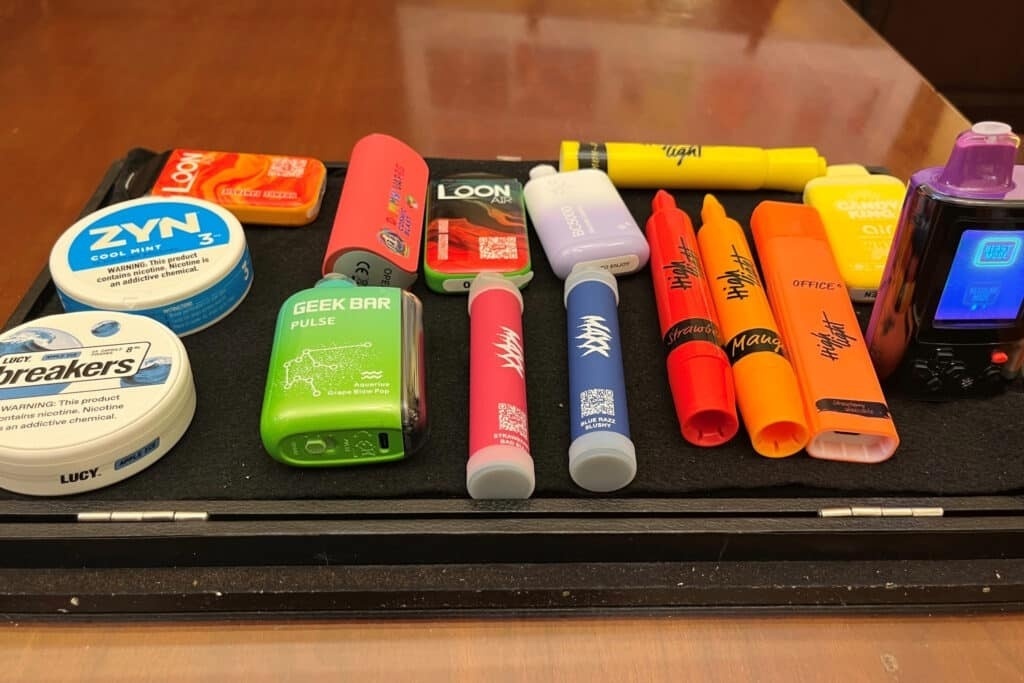
Minnesota Democrat Attorney General Keith Ellison showcased banned products at a press conference, including GEEK BAR and ZYN nicotine pouches.

According to a recent report by Alpha News, Democratic Attorney General Keith Ellison of Minnesota showcased a range of banned products at a press conference, including the e-cigarette brand GEEK BAR and ZYN nicotine pouches.


Two weeks ago, Ellison announced at a press conference that his office had sent a letter to over 5,000 businesses in Minnesota, demanding that retailers "immediately cease selling or distributing illegal and unauthorized e-cigarettes or nicotine pouches.


According to the Office of the Attorney General, federal law states that "all new tobacco products - whether containing tobacco-derived nicotine or synthetic nicotine - must obtain FDA market authorization before being legally sold.


The ZYN nicotine pouch has not yet received authorization from the FDA.


Ellison wrote in a letter to retailers,


As of June 2024, the FDA has only authorized the sale of 34 e-cigarette products and 4 oral nicotine products (none of which are nicotine pouches).


Alpha News has reached out multiple times to Attorney General Ellison's office to confirm whether he directed retailers in Minnesota to stop selling ZYN, but the Attorney General's office has refused to respond on various platforms. The media outlet also inquired about the actions Attorney General Ellison's office would take against businesses continuing to sell ZYN, but a spokesperson for the Attorney General's office did not provide a response.


The e-cigarette media outlet Vaping360 stated that Ellison's office does not have the correct facts.


Elison claimed in the letter that unauthorized e-cigarette and nicotine pouch retailers are in violation of the Federal Food, Drug, and Cosmetic Act, which is not entirely accurate.


The FDA did not attempt to enforce these regulations on manufacturers whose products are still under review or on manufacturers who have obtained a Marketing Denial Order (MDO) that has been suspended or overturned by a federal court.


If Ellison is correct, then manufacturers currently selling Joye-cigarettes or ZYN nicotine pouches should face legal action - even though these products are still under FDA review, and the FDA itself has not taken action against the distributors or retailers selling these products.


These actions are part of the Attorney General's request for retailers to stop selling ZYN in Minnesota, with the aim of preventing the sale of illegal e-cigarettes and electronic nicotine delivery systems.


In the letter, Ellison specifically points out that if retailers advertise, sell, or distribute e-cigarettes as imitating candy, desserts, or beverages typically marketed to minors, they will be in violation of state laws. He also requests that the contacted companies provide written confirmation that they will cease selling unauthorized products.


I request that you provide written confirmation that you will comply with the aforementioned laws, cease advertising, selling, or distributing unauthorized and illegal e-cigarette and nicotine pouches to consumers in Minnesota, and ensure that only FDA-approved e-cigarette and nicotine pouch products are advertised, sold, or distributed.


We welcome news tips, article submissions, interview requests, or comments on this piece.

Please contact us at info@2firsts.com, or reach out to Alan Zhao, CEO of 2Firsts, on LinkedIn


Notice

1.  This article is intended solely for professional research purposes related to industry, technology, and policy. Any references to brands or products are made purely for objective description and do not constitute any form of endorsement, recommendation, or promotion by 2Firsts.

2.  The use of nicotine-containing products — including, but not limited to, cigarettes, e-cigarettes, nicotine pouchand heated tobacco products — carries significant health risks. Users are responsible for complying with all applicable laws and regulations in their respective jurisdictions.

3.  This article is not intended to serve as the basis for any investment decisions or financial advice. 2Firsts assumes no direct or indirect liability for any inaccuracies or errors in the content.

4.  Access to this article is strictly prohibited for individuals below the legal age in their jurisdiction.


Copyright


This article is either an original work created by 2Firsts or a reproduction from third-party sources with proper attribution. All copyrights and usage rights belong to 2Firsts or the original content provider. Unauthorized reproduction, distribution, or any other form of unauthorized use by any individual or organization is strictly prohibited. Violators will be held legally accountable.

For copyright-related inquiries, please contact: info@2firsts.com


AI Assistance Disclaimer


This article may have been enhanced using AI tools to improve translation and editorial efficiency. However, due to technical limitations, inaccuracies may occur. Readers are encouraged to refer to the cited sources for the most accurate information.

We welcome any corrections or feedback. Please contact us at: info@2firsts.com

UK Directors Banned After 352,688 Vapes Imported From China Were Misdeclared as Medical Nebulizers in £15 Million Tax Case
The UK Insolvency Service said YSK Enterprises imported large quantities of vapes from China in 2023, with a shipment addressed to the company declared as medical nebulizers before Border Force found 352,688 vaping products. HMRC calculated nearly £15 million ($20.3 million) in unpaid VAT and customs duty, alongside about £437,000 in corporation tax. Two directors were disqualified for nine years. The case predates the UK's Vaping Products Duty, which will introduce vape-specific excise and duty-stamp requirements from October 2026.
Regulations
Sep.11
China Tobacco Regulator Deputy Head Visits Laos as Both Sides Strengthen Cooperation on Illegal Tobacco Trade
China’s official Xinhua News Agency reported that Liu Sanjiang, deputy head and Party group member of China’s tobacco regulator, led a delegation to Laos from July 31 to Aug. 2, 2026, for discussions with Lao authorities on combating cross-border illegal tobacco trade. The two sides discussed areas including law enforcement cooperation, information sharing and efforts to address tobacco-related illegal activities such as counterfeiting and smuggling. The visit highlights cooperation between Chinese and Lao authorities on illicit tobacco control.
News
Aug.05
California Lawmakers Pass Disposable Nicotine Vape Ban, With Sales Prohibition Set for 2028
According to CBS Los Angeles on August 27, 2026, California lawmakers have passed Assembly Bill 762, which would phase out disposable, battery-embedded nicotine vapes in the state. If signed by Governor Gavin Newsom, manufacturing and importation of the covered products would be prohibited beginning January 1, 2027, followed by a sales ban on January 1, 2028. Driven primarily by concerns over electronic waste, lithium-battery fires and environmental pollution, the legislation would further shift California’s legal vape market toward rechargeable, refillable or replaceable-pod devices.
Aug.28
JT Plans ¥800 Billion Investment in Heated Tobacco Over Three Years, Betting on Ploom as Second Growth Engine
Japan Tobacco Inc. (JT) CEO Takehiko Tsutsui said the company plans to invest about ¥800 billion (approximately US$5.4 billion) in heated tobacco products over three years through 2028, aiming to establish Ploom as a second growth engine after combustible cigarettes. Tsutsui said Ploom AURA helped JT increase its share of Japan’s heated tobacco market to 15.8% in the first quarter of 2026. Ploom products are now available in 29 markets, with Ploom AURA sold in 25 markets including Japan. JT also plans to continue its cigarette business while positioning its food operations, particularly frozen noodle products in North America, as another growth opportunity.
Jul.23
Juul Sublicense Reshapes Vuse Alto Patent Bill as Court Ends R.J. Reynolds’ 5.25% Royalty Obligation to Altria
According to Law360 on August 31, 2026, a federal judge in North Carolina ruled that a patent sublicense between R.J. Reynolds Vapor Co. and Juul Labs Inc. relieves Reynolds of its obligation to continue paying royalties to Altria Client Services LLC over Vuse Alto. A jury had previously found that Vuse Alto infringed three Altria patents and awarded approximately $95.2 million in past damages, after which Reynolds was ordered to pay an ongoing royalty equal to 5.25% of positive net sales. The new ruling finds that a valid sublicense can eliminate future infringement, potentially ending what Altria described as hundreds of millions of dollars in future royalties.
Sep.01
PMI Expands U.S. ZYN Portfolio With New 1.5 mg and 8 mg Strengths, Moves Toward a Unified 20-Pouch-Per-Can Format
Philip Morris International is expanding its U.S. ZYN nicotine pouch portfolio with new 1.5 mg and 8 mg strengths and plans to move its core 3 mg and 6 mg dry-pouch products from 15 to 20 pouches per can in the fourth quarter of 2026. ZYN ULTRA is also commercially available, with FDA authorization covering 10 products at 9 mg and one 11 mg Smooth product. PMI U.S. lists the new 1.5 mg and 8 mg strengths as commercially available, but as of September 10 they do not appear on the FDA’s public authorization list. Public materials do not identify which PMTA submissions cover the two new strengths or their current review status.
Sep.11